Recall history
Audi Q5 recalls: check if yours is affected
The DVSA recall record for the Audi Q5: 29 recalls issued between 2010 and 2026, and how to check one car.
Updated 25th October 2026 MOT record: Honest Car Check counted 116,966 DVSA MOT tests for the Audi Q5, and 13.8% failed.
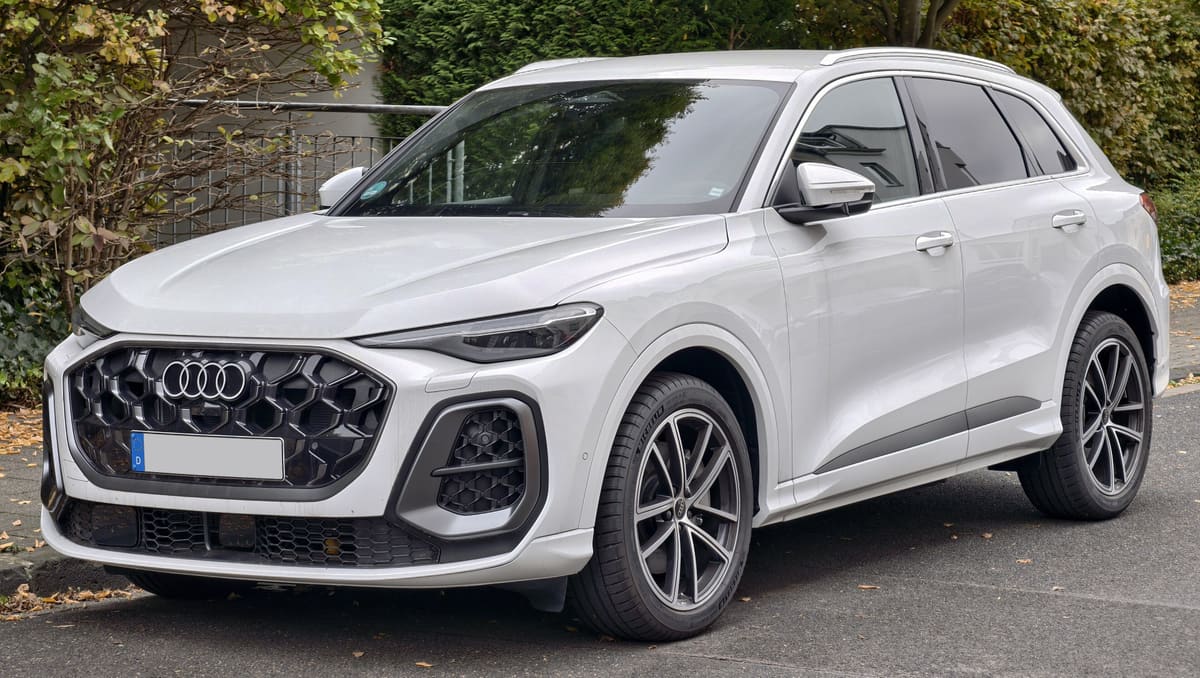
The recalls on record
The 20 most recent of the 29 are listed here, newest first.
| Issued | Reference | What it concerns | Cars built |
|---|---|---|---|
| 4 May 2026 | R/2026/192 | Replacing seat belt with tensioner | Jul 2025 to Nov 2025 |
| 24 October 2025 | R/2025/463 | Software update for battery control unit | Mar 2021 to Jul 2024 |
| 8 August 2025 | R/2025/387 | Stop-drive TAKATA PSAN | Oct 2008 to Dec 2011 |
| 22 May 2025 | R/2025/184 | Cylinder head cover bolts inspection | Sep 2020 to Aug 2024 |
| 9 December 2024 | R/2024/495 | Servicing high-voltage battery | Mar 2021 to Dec 2022 |
| 6 February 2023 | R/2023/052 | If a front airbag is deployed it is possible that the gas generator housing in which the propellant is generated may burst on vehicles manufactured within a limited period | Oct 2008 to Aug 2012 |
| 24 August 2022 | R/2022/291 | INNER AND OUTER SHEET METAL COMPONENTS OF REAR TAILGATE MAY NOT HAVE BEEN JOINED SUFFICIENTLY | Oct 2021 |
| 10 June 2022 | R/2022/169 | ENGINE CONTROL UNITS MIGHT BE FITTED WITH SEMICONDUCTOR COMPONENTS THAT DO NOT MEET SPECIFICATIONS | Jan 2022 to Feb 2022 |
| 14 February 2022 | R/2022/036 | FOLLOWING A PREVIOUS CAMPAIGN THE TOE AND/OR CAMBER VALUES ON THE REAR AXLE MAY IN CERTAIN CIRCUMSTANCES INCORRECTLY BE CHANGED WITHOUT THIS BEING NOTICED | Nov 2019 to Feb 2021 |
| 25 June 2021 | R/2021/236 | REAR AXLE SUSPENSION LINKS NUTS DO NOT MEET SPECIFICATIONS | Nov 2019 to Feb 2021 |
| 8 September 2020 | R/2020/260 | THE BACKREST ADJUSTMENT MECHANISM GAP MAY BE FAULTY ON INDIVIDUAL FRONT SEATS | Jun 2020 to Jul 2020 |
| 30 June 2020 | R/2020/138 | MOISTURE MAY ENTER THE BELT-DRIVEN STARTER-ALTERNATOR | Jun 2017 to Mar 2020 |
| 27 March 2020 | R/2020/115 | THERE MAY BE INCREASED PEDAL TRAVEL AS A RESULT OF PRODUCTION TOLERANCES | Jan 2020 |
| 23 October 2019 | R/2019/363 | THE COLLAR OF THE WHEEL ARCH COVER CAN BECOME DETACHED | Nov 2016 to Oct 2019 |
| 22 July 2019 | R/2019/233 | LATCHING CONNECTION ON THE WHEEL HOUSING LINER MAY FAIL | Nov 2016 to Dec 2018 |
| 10 July 2019 | R/2019/225 | IT IS POSSIBLE THAT THE LATCHING CONNECTION ON THE WHEEL HOUSING LINER MAY FAIL | Nov 2016 to Dec 2018 |
| 16 April 2019 | R/2019/126 | THE BRAKE MASTER CYLINDER MAY NOT MEET THE SPECIFICATIONS | Aug 2018 to Nov 2018 |
| 1 October 2018 | R/2018/149 | BRAKE PISTON MAY NOT HAVE BEEN COATED CORRECTLY | Apr 2018 to May 2018 |
| 18 June 2018 | R/2018/161 | REAR BRAKE PISTONS COATED INCORRECTLY | Mar 2018 to Apr 2018 |
| 19 February 2018 | R/2018/051 | AUXILLIARY HEATER ELEMENT IN AIR CONDITIONING MAY FAIL AND/OR OVERHEAT | Apr 2011 to Jul 2015 |
A DVSA recall can name several models at once, so one listed here may cover other models too. The recall record further down this page gives the defect and the fix for the 12 most recent; the older entries above carry DVSA’s summary only.
How to check one car
A recall applies to particular cars, not to every Audi Q5, so one listed here may not apply to the car you are looking at. Enter the registration and the free check shows whether DVSA has an outstanding recall logged against that car.
Where this comes from
DVSA vehicle safety recalls, published under the Open Government Licence v3.0, matched to the Audi Q5 by make and model name. Our copy of the DVSA file was last refreshed on 7 September 2026.
Audi Q5 recall record
29 recalls have been issued for the Audi Q5, between 2010 and 2026.
Replacing seat belt with tensioner
R/2026/192Issued 4 May 2026
On Audi Q5 vehicles manufactured within a specific period the belt tensioning function on the front seats does not comply with technical requirements. Although the seat belt is tightened in the event of an accident which requires this it cannot be held tight reliably which reduces the protective effect. For this reason one or both front seat belts – as required – will be replaced on affected Q5 vehicles.
Remedy: Recall campaign 69GT must be performed on affected vehicles and the affected seat belts must be replaced as described in the Workshop Manual.
Affects cars built Jul 2025 to Nov 2025
Software update for battery control unit
R/2025/463Issued 24 October 2025
On affected vehicles there may be defective battery modules which may result in a fire hazard when charging the high-voltage battery.
Remedy: Update the software of the high-voltage battery to improve the self-diagnosis capabilities. Vehicle owners are advised to not charge the high-voltage battery using external charging sources and also not use the e-tron modes “Battery charge” and “Battery hold” until the update is applied.
Affects cars built Mar 2021 to Jul 2024
Stop-drive TAKATA PSAN
R/2025/387Issued 8 August 2025
Urgent Safety Warning – Do Not Drive Your Vehicle Affected vehicles were originally allocated to or used for an extended period of time in a region with a climate zone considered to as HIGH RISK. Certain front airbags contain an ageing inflator propellant that may explode when deployed due to long-term exposure to heat and humidity. If the airbag inflator explodes metal fragments may be ejected causing life-threatening or fatal injuries to anyone in the vehicle.
Remedy: Affected airbags will be be replaced. You can contact Audi's dedicated Takata Stop Drive helpline at 0113 526 9646 (MONDAY to FRIDAY 9:00AM to 5:00PM.
Affects cars built Oct 2008 to Dec 2011
Cylinder head cover bolts inspection
R/2025/184Issued 22 May 2025
Audi conducts programmes to constantly monitor the quality of its products. As part of this we have discovered that individual bolts in the cylinder head cover area on your vehicle may become loose as a result of a manufacturing issue. Depending on the extent to which the bolts become loose engine oil may leak and drip onto hot surfaces which poses a fire risk. If you notice smoke in the engine compartment park the vehicle safely and without delay.
Remedy: To ensure the bolts are secured correctly a check must be performed.
Affects cars built Sept 2020 to Aug 2024
Servicing high-voltage battery
R/2024/495Issued 9 December 2024
On affected vehicles battery modules may become defective over the course of the vehicle’s service life. This may result in a fire hazard when charging the high-voltage battery with the associated risk of severe or fatal injuries to people inside and/or outside the vehicle as well as significant material damage. To minimise this risk do not charge the high-voltage battery using an external charging source. In addition do not use the e-tron modes “Battery charge” and “Battery hold” (refer to Owner’s Manual) until further notice.
Remedy: Replace the defective modules. Further software fix being developed to improve monitoring.
Affects cars built Mar 2021 to Dec 2022
If a front airbag is deployed it is possible that the gas generator housing in which the propellant is generated may burst on vehicles manufactured within a limited period.
R/2023/052Issued 6 February 2023
If a front airbag is deployed it is possible that the gas generator housing in which the propellant is generated may burst on vehicles manufactured within a limited period.
Remedy: As a precautionary safety measure it is necessary to replace the airbag unit on the driver side.
Affects cars built Oct 2008 to Aug 2012
INNER AND OUTER SHEET METAL COMPONENTS OF REAR TAILGATE MAY NOT HAVE BEEN JOINED SUFFICIENTLY
R/2022/291Issued 24 August 2022
The inner and outer sheet metal components of the rear lid may not have been joined together sufficiently well in the manufacturing process.
Remedy: Replace the rear lid of the affected vehicles.
Affects cars built Oct 2021 to Oct 2021
ENGINE CONTROL UNITS MIGHT BE FITTED WITH SEMICONDUCTOR COMPONENTS THAT DO NOT MEET SPECIFICATIONS
R/2022/169Issued 10 June 2022
On a small number of vehicles manufactured within a specific period it is possible that the engine control units were fitted with semiconductor components which do not meet the specifications.
Remedy: The engine control unit must be replaced on the affected vehicles.
Affects cars built Jan 2022 to Feb 2022
FOLLOWING A PREVIOUS CAMPAIGN THE TOE AND/OR CAMBER VALUES ON THE REAR AXLE MAY IN CERTAIN CIRCUMSTANCES INCORRECTLY BE CHANGED WITHOUT THIS BEING NOTICED
R/2022/036Issued 14 February 2022
Following a previous campaign the toe and/or camber values on the rear axle may in certain circumstances incorrectly be changed without this being noticed.
Remedy: The wheel alignment must be checked and if necessary the suspension must be serviced on the affected vehicles.
Affects cars built Nov 2019 to Feb 2021
REAR AXLE SUSPENSION LINKS NUTS DO NOT MEET SPECIFICATIONS
R/2021/236Issued 25 June 2021
One or more nuts which do not meet the specifications may have been fitted on the rear axle suspension links.
Remedy: The affected nuts on the rear axle will be replaced on affected vehicles.
Affects cars built Nov 2019 to Feb 2021
THE BACKREST ADJUSTMENT MECHANISM GAP MAY BE FAULTY ON INDIVIDUAL FRONT SEATS
R/2020/260Issued 8 September 2020
It is possible that the gap on the adjusting mechanism for the backrest may be faulty on individual front seats.
Remedy: On the affected vehicles the backrests of the front seats are to be checked and replaced if necessary.
Affects cars built Jun 2020 to Jul 2020
MOISTURE MAY ENTER THE BELT-DRIVEN STARTER-ALTERNATOR
R/2020/138Issued 30 June 2020
It is possible that moisture may enter the belt-driven starter-alternator.
Remedy: The starter-alternator must be replaced on the affected vehicles.
Affects cars built Jun 2017 to Mar 2020
17 older recalls not shown.
A recall applies to a build range, not to every car of this model. Check a registration to see whether one specific vehicle has an outstanding recall.
Audi Q5 MOT record
Honest Car Check counted 116,966 DVSA MOT tests for the Audi Q5, and 13.8% failed.
| Registered | Tests | Failed | Median mileage |
|---|---|---|---|
| 2023 | 420 | 2.6% | 25,222 mi |
| 2022 | 9,405 | 6.2% | 27,625 mi |
| 2021 | 11,238 | 8.0% | 36,322 mi |
| 2020 | 8,679 | 8.0% | 44,304 mi |
| 2019 | 11,836 | 9.0% | 51,833 mi |
| 2018 | 12,945 | 11.5% | 59,179 mi |
| 2017 | 9,881 | 15.5% | 68,389 mi |
| 2016 | 11,086 | 14.7% | 79,085 mi |
Most common reasons for failure
- A suspension pin, bush or joint excessively worn30.6%
- Tyre tread depth not in accordance with the requirements30.3%
- A tyre seriously damaged15.4%
- a brake lining or pad worn below 1.5mm13.7%
- A transmission shaft constant velocity joint boot missing or no longer prevents the ingress of dirt etc10.0%
Figures cover every car recorded under this model name in the DVSA dataset, retests left out. They describe the model, not this specific car. Check a registration for the actual history of one vehicle.
Audi Q5 official figures
Median across 12 variants on sale, diesel electric, electricity / petrol, petrol electric.
- Combined economy
- 40.4 mpg
- WLTP median across variants
- CO2 emissions
- 164.5 g/km
- Sets the first-year tax rate
Official figures for new cars. Real economy varies with driving, load and conditions.
Frequently asked questions
How can I find out if my Audi Q5 has been recalled?
Enter the registration and the free check shows whether DVSA has an outstanding recall logged against that car. A recall is issued against particular vehicles, so the model's record alone cannot say whether one car is affected.
Does every Audi Q5 have the recalls listed here?
No. A recall applies to particular cars, not to every Audi Q5. Check the registration to see what DVSA holds for one car.
Sources