Running costs
Toyota C-HR running costs: what UK ownership really costs
Toyota C-HR UK running costs: fuel or electric, insurance group, road tax, servicing and depreciation.
Updated 12th October 2026 DVSA data: Across 101,851 recorded MOT tests, 9.3% failed.
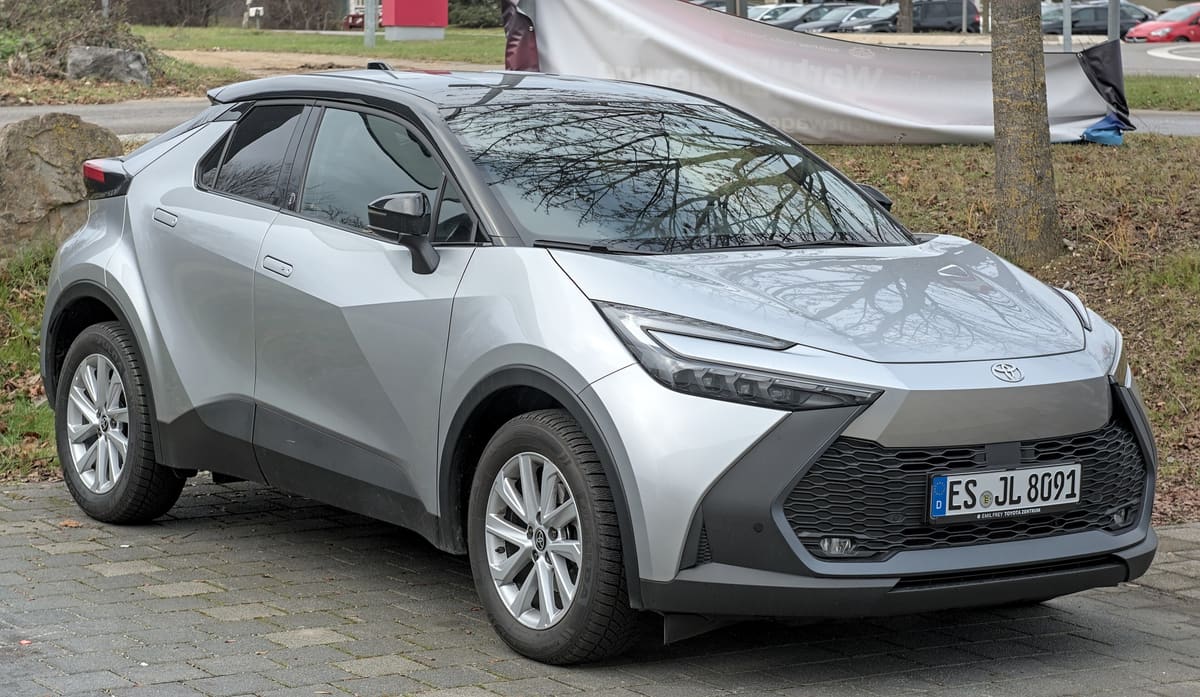
The Toyota C-HR’s running costs are influenced by its hybrid powertrain efficiency, insurance grouping, tax treatment based on emissions, and servicing requirements. Its hybrid technology tends to reduce fuel expenditure and road tax liability, while insurance costs depend on trim and driver profile. Servicing is straightforward but can be pricier than conventional small cars, and residual values remain strong due to Toyota’s reputation and hybrid appeal.
How Vehicle Tax Affects the Toyota C-HR
The Toyota C-HR benefits from the UK’s vehicle tax system that favours lower-emission cars. Since many C-HR models are hybrids, their CO2 emissions are generally lower than equivalent petrol or diesel vehicles, which usually results in reduced annual road tax costs. The exact tax band depends on the specific engine and trim, so checking the official government vehicle tax checker is essential.
Road tax for petrol and diesel cars is based primarily on CO2 emissions, with lower emissions attracting lower rates or even exemption in some cases. Hybrids often fall into favourable bands because their combined emissions are less than traditional engines. This means the C-HR can be more economical to tax than non-hybrid rivals in the same segment. However, plug-in hybrid variants may attract different tax treatments depending on electric range and emissions figures.
Vehicle Excise Duty (VED) is paid annually, and the government website provides up-to-date information on the exact rates for each model variant. Buyers should confirm the tax band of the specific C-HR trim they are considering, as this can vary significantly with engine type and model year.
Insurance Group and What Influences It
The Toyota C-HR’s insurance group rating is determined by factors such as engine size, repair costs, safety features, and the likelihood of theft or accident claims. Generally, the C-HR sits in a moderate insurance group for its class, reflecting its hybrid technology and safety equipment.
Higher trim levels with more powerful engines or additional luxury features can push the insurance group up, as these versions may cost more to repair or replace. Conversely, lower-powered trims or those with fewer extras might fall into lower groups. The presence of advanced safety aids, such as autonomous emergency braking and lane-keeping assist, can help reduce insurance premiums by lowering the risk of accidents.
Driver profile also plays a significant role in insurance costs. Factors like age, driving history, and location will affect the premium. Obtaining a personalised quote from insurance providers is the best way to understand the cost implications for an individual driver.
Servicing Demands and Costs
The Toyota C-HR’s servicing requirements are generally straightforward but can be more involved than a conventional petrol-only small SUV due to its hybrid system. Routine maintenance includes standard oil changes, brake checks, and tyre inspections, but the hybrid battery and electric motor components require specialist attention.
Hybrid vehicles often benefit from regenerative braking, which reduces wear on brake pads and discs, potentially lowering replacement frequency and cost. However, hybrid systems require periodic health checks to ensure battery performance and electrical components are functioning correctly. These checks may add to servicing costs compared to non-hybrid vehicles.
Toyota’s servicing intervals for the C-HR are designed to balance reliability with cost-effectiveness, but hybrid repairs or battery replacements, though rare within typical ownership periods, can be expensive if needed. It is advisable to follow the manufacturer’s recommended service schedule and use authorised service centres to maintain warranty coverage and vehicle reliability.
Fuel Economy and Running Costs
The hybrid powertrain in the Toyota C-HR is designed to optimise fuel efficiency by combining a petrol engine with electric assistance. This setup typically results in lower fuel consumption compared to conventional petrol or diesel SUVs of similar size and performance, especially in urban driving conditions where electric power can be used more extensively.
Fuel savings are most noticeable in stop-start traffic and short journeys, where the electric motor can handle low-speed driving without engaging the petrol engine. On longer motorway trips, the petrol engine will do most of the work, so fuel economy benefits may be less pronounced.
Drivers should consider that actual fuel costs depend on driving style, route, and traffic conditions. Hybrid technology reduces fuel bills but may come with a slightly higher purchase price, which can be offset over time through savings on fuel and tax.
Residual Values and Depreciation
The Toyota C-HR tends to hold its value well compared to many other small SUVs, largely due to Toyota’s reputation for reliability and the growing demand for hybrid vehicles. Strong residual values help reduce the overall cost of ownership by lowering depreciation losses when it comes time to sell or part-exchange.
Hybrid vehicles are increasingly popular in the used car market, and the C-HR’s combination of style, efficiency, and Toyota’s brand strength contributes to sustained demand. This demand supports better resale prices compared to some purely petrol or diesel rivals.
Depreciation rates vary depending on factors such as mileage, condition, and trim level. Keeping the vehicle well maintained and retaining full service history can help maximise resale value. Buyers should compare valuations for different trims and model years to understand how depreciation might affect their ownership costs.
Summary of Running Cost Considerations
The Toyota C-HR’s running costs are shaped by its hybrid technology, which reduces fuel and tax expenses but may increase servicing complexity. Insurance costs vary with trim and driver profile, while residual values remain strong thanks to Toyota’s reliability and hybrid appeal. Prospective buyers should assess specific trims for tax bands, insurance groups, and servicing needs to get an accurate picture of ownership costs.
Toyota C-HR recall record
15 recalls have been issued for the Toyota C-HR, between 2017 and 2025.
Parking Assist ECU reprogram on multiple models
R/2025/466Issued 1 December 2025
For certain vehicles equipped with a Parking Assist ECU a component of the Panoramic View Monitor (PVM) system that displays the rear view image the software may cause the rear view image to freeze or not display
Remedy:Reprogram the parking assist ECU.
Affects cars built Sept 2023 to Sept 2025
Combination Meter Reprogramming on Multiple Models
R/2025/270Issued 24 November 2025
For certain vehicles equipped with the combination meter system (where various information is displayed) that due to an improper programming of the combination meter unnecessarily repetitive data is written to a memory device. This may cause the memory device to deteriorate and the monitor to not display during the meter at start up and remain in this state permanently.
Remedy:Reprogram or replace the combination meter.
Affects cars built May 2023 to Dec 2024
High-Pressure Fuel Pump replacement on multiple models
R/2024/514Issued 20 January 2025
For certain vehicles that were affected by a previous campaign announced in October 2023 for high-pressure fuel pump a further check is required to confirm if the correct pump is fitted.
Remedy:A check of the high-pressure fuel pump and replace if necessary.
Affects cars built May 2018 to Feb 2022
Remote Parking via Mobile App on Certain Toyota C-HR
R/2023/349Issued 19 February 2024
Affected vehicles are equipped with an advanced park system which can be operated remotely by the driver when outside the vehicle using a smartphone application. There is a risk an error may occur in an Electronic Control Unit (ECU) when the finger movements on the smartphone application are stopped or the finger is removed within three seconds after the remote-control function is activated. If this occurs the shift range will be changed from Park to Drive or Reverse and the brakes will be released without any finger operation on the smartphone resulting in the vehicle creeping forward or backward which could increase the risk of a crash.
Remedy:Reprogram the Clearance Sonar Electronic Control Unit (ECU) and Brake Electronic Control Unit (ECU) with modified software.
Affects cars built Sept 2023 to Dec 2023
11 older recalls not shown.
A recall applies to a build range, not to every car of this model. Check a registration to see whether one specific vehicle has an outstanding recall.
Toyota C-HR MOT record
From 101,851 recorded MOT tests, 9.3% failed.
| Registered | Tests | Failed | Median mileage |
|---|---|---|---|
| 2023 | 1,315 | 2.7% | 20,574 mi |
| 2022 | 17,118 | 5.1% | 22,400 mi |
| 2021 | 17,310 | 7.7% | 30,748 mi |
| 2020 | 16,042 | 9.9% | 38,375 mi |
| 2019 | 17,400 | 10.3% | 45,613 mi |
| 2018 | 18,285 | 11.2% | 54,454 mi |
| 2017 | 13,898 | 12.4% | 59,202 mi |
| 2016 | 483 | 13.5% | 61,456 mi |
Most common reasons for failure
- Tyre tread depth not in accordance with the requirements30.7%
- A tyre seriously damaged30.3%
- Wiper blade missing or obviously not clearing the windscreen15.3%
- a brake lining or pad worn below 1.5mm12.1%
- Brake disc or drum excessively weakened, insecure or fractured11.6%
Figures cover every Toyota C-HR tested in the DVSA dataset, not this specific car. Check a registration for the actual history of one vehicle.
Toyota C-HR official figures
Median across 33 variants on sale, electricity, electricity / petrol, petrol electric.
- Combined economy
- 58.9 mpg
- WLTP median across variants
- CO2 emissions
- 106 g/km
- Sets the first-year tax rate
- Electric range
- 345 miles
- Manufacturer WLTP figure
Official figures for new cars. Real economy varies with driving, load and conditions.
Frequently asked questions
How expensive is servicing a Toyota C-HR?
Servicing a Toyota C-HR typically involves checks and replacements like engine oil, oil filter, and air filter. The hybrid models also require inspection of the hybrid battery cooling system. Regular servicing helps maintain the health of components such as brake pads and spark plugs.
What should I watch for regarding the Toyota C-HR’s hybrid battery?
The hybrid battery in the Toyota C-HR is designed to last, but you should monitor for warning lights on the dashboard related to the hybrid system. If you notice reduced performance or unusual noises from the engine bay, it’s wise to have the battery and associated cooling system checked by a specialist.
Are Toyota C-HR tyres costly to replace?
Tyres for the Toyota C-HR are generally standard sizes, so replacements are widely available. Checking tyre tread depth regularly and looking out for uneven wear can help avoid premature replacement. Tyre condition affects fuel efficiency and safety, so it’s important to keep them in good shape.
Does the Toyota C-HR require special brake maintenance?
The Toyota C-HR uses regenerative braking in hybrid models, which can extend the life of brake pads. However, it’s important to have the brake discs and pads inspected during servicing for wear or scoring. Brake fluid should also be replaced at intervals to maintain braking performance.
What are typical fuel costs for a Toyota C-HR hybrid?
Fuel costs depend on driving style and conditions, but the Toyota C-HR hybrid benefits from regenerative braking and electric motor assistance to reduce petrol consumption. Keeping the tyres properly inflated and avoiding heavy acceleration can help maximise fuel efficiency.
How often does the Toyota C-HR need a timing belt or chain replacement?
The Toyota C-HR is fitted with a timing chain rather than a belt, which usually lasts the lifetime of the engine without scheduled replacement. However, if you hear rattling noises from the engine or experience rough running, it’s worth having the timing chain and tensioner inspected.
Are there any specific checks I should do before buying a used Toyota C-HR?
Before purchasing a used Toyota C-HR, check the service history for regular maintenance of hybrid components and engine oil changes. Inspect the hybrid battery warning light on the dashboard and test the air conditioning system, as repairs to the climate control can be costly.
What maintenance does the Toyota C-HR’s air conditioning system need?
The air conditioning system in the Toyota C-HR should be checked for refrigerant levels and leaks during servicing. Listen for unusual noises from the blower motor and ensure the system cools effectively. Faulty AC compressors or leaks in the pipes can lead to expensive repairs if ignored.
Sources
- DVSA anonymised MOT tests and results (Open Government Licence v3.0)
- VCA new car fuel consumption and emissions data (Open Government Licence v3.0)
- DVSA vehicle safety recalls (Open Government Licence v3.0)