Running costs
Audi Q7 running costs: what UK ownership really costs
Audi Q7 UK running costs: fuel or electric, insurance group, road tax, servicing and depreciation.
Updated 4th September 2026 DVSA data: Across 49,531 recorded MOT tests, 14.6% failed.
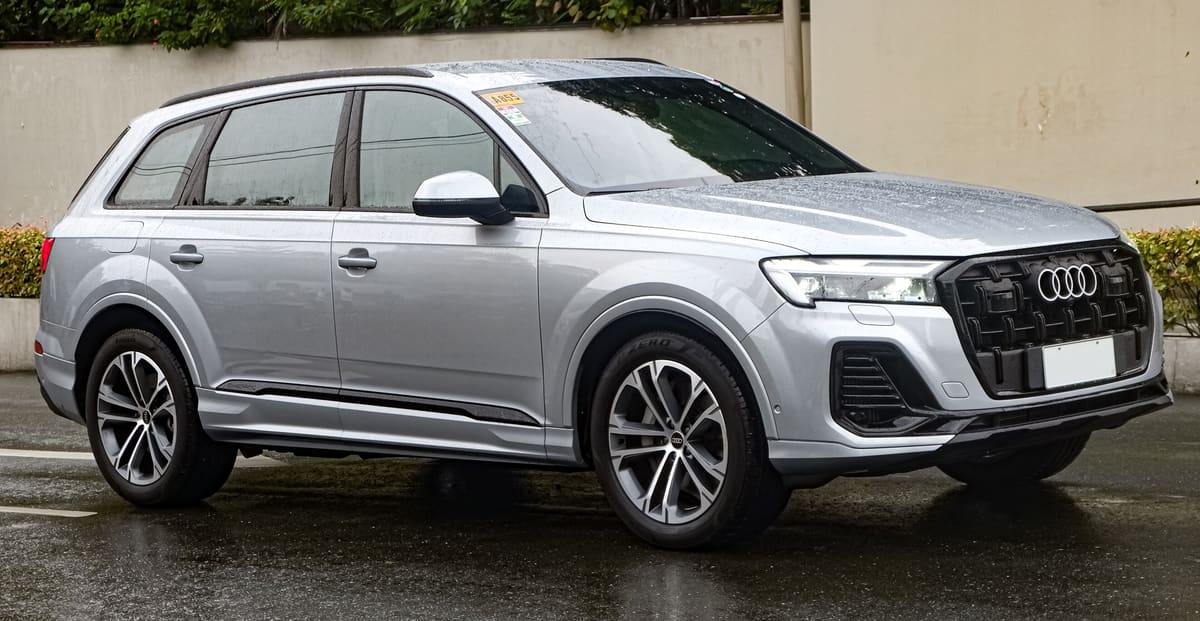
The Audi Q7 is a premium SUV that offers a blend of luxury and practicality. However, potential owners should consider its running costs, which include fuel or electric expenses, insurance groups, tax bands, servicing intervals, and typical depreciation. These factors significantly influence the total ownership cost.
Fuel and Electric Costs
The fuel efficiency of the Audi Q7 varies depending on the engine choice. The plug-in hybrid (PHEV) variant provides an electric-only range of about 30 miles, making it suitable for short commutes.
For diesel, prices are usually slightly lower. If you opt for the PHEV, charging at home can be economical, especially with off-peak electricity rates. Overall, fuel costs can be substantial, particularly for high-mileage drivers.
Insurance Group
The Audi Q7 falls into higher insurance groups, typically ranging from group 40 to 50, depending on the specific model and trim level. This classification reflects the vehicle’s value, performance, and repair costs, which can lead to higher premiums.
For example, the more powerful models with advanced features may attract higher insurance costs. It’s advisable for potential buyers to obtain insurance quotes before purchasing to gauge the financial implications. Additionally, factors such as the driver’s age, location, and driving history can influence insurance rates significantly.
Tax Band
Vehicle Excise Duty (VED), commonly known as road tax, is another cost to consider. The Audi Q7 generally falls into higher tax bands due to its emissions.
The plug-in hybrid version benefits from lower emissions, potentially placing it in a lower tax band, which can save owners money. It’s essential to check the specific emissions figures for the model you are considering, as this will determine the exact tax costs.
Servicing Intervals
The Audi Q7 has recommended servicing intervals of approximately 12 months or 10,000 miles, whichever comes first. Regular servicing is crucial for maintaining performance and reliability, especially for a luxury vehicle.
Audi’s servicing can be more expensive than average, so owners should factor this into their budget. Additionally, using an independent garage may offer cost savings, but it is vital to ensure that any work done does not void the warranty. Regular maintenance can help prevent costly repairs down the line.
Typical Depreciation
Depreciation is a significant factor in the total ownership cost of the Audi Q7. Luxury SUVs tend to lose value more rapidly than smaller cars, with estimates suggesting that the Q7 can depreciate by around 50-60% over five years.
Factors influencing depreciation include mileage, condition, and market demand. The Q7’s reputation for quality and reliability may help mitigate some depreciation, but potential buyers should be aware that resale values can be lower compared to non-premium rivals. Keeping the vehicle well-maintained can help preserve its value over time.
Conclusion
Owning an Audi Q7 comes with various running costs that can add up significantly. Fuel or electric expenses, insurance premiums, road tax, servicing intervals, and depreciation all contribute to the total cost of ownership. Prospective buyers should carefully evaluate these factors to ensure that the Q7 aligns with their financial expectations and lifestyle.
Audi Q7 recall record
16 recalls have been issued for the Audi Q7, between 2007 and 2025.
Software update for battery control unit
R/2025/441Issued 10 October 2025
On affected vehicles there may be defective battery modules which may result in a fire hazard when charging the high-voltage battery.
Remedy:Update the software of the high-voltage battery to improve the self-diagnosis capabilities. Vehicle owners are advised to not charge the high-voltage battery using external charging sources and also not use the e-tron modes “Battery charge” and “Battery hold” until the update is applied.
Affects cars built Nov 2020 to Oct 2023
The function of the side airbag may be restricted due to the airbag not being sufficiently secured to the front left seat frame.
R/2024/018Issued 15 January 2024
The function of the side airbag may be restricted due to the airbag not being sufficiently secured to the front left seat frame.
Remedy:Conduct a check of the airbag to ensure it is secured correctly; if necessary the side airbag is to be correctly hooked in position and resecured.
Affects cars built Aug 2023 to Oct 2023
A weld seam on the outer backrest frame of the front seats may not have been made correctly.
R/2023/331Issued 10 November 2023
A weld seam on the outer backrest frame of the front seats may not have been made correctly.�
Remedy:Check the front seats and if required to replace the affected backrest.
Affects cars built Jun 2023 to Jun 2023
FOLLOWING A PREVIOUS CAMPAIGN THE TOE AND/OR CAMBER VALUES ON THE REAR AXLE MAY IN CERTAIN CIRCUMSTANCES INCORRECTLY BE CHANGED WITHOUT THIS BEING NOTICED
R/2022/036Issued 14 February 2022
Following a previous campaign the toe and/or camber values on the rear axle may in certain circumstances incorrectly be changed without this being noticed.
Remedy:The wheel alignment must be checked and if necessary the suspension must be serviced on the affected vehicles.
Affects cars built Nov 2019 to Feb 2021
12 older recalls not shown.
A recall applies to a build range, not to every car of this model. Check a registration to see whether one specific vehicle has an outstanding recall.
Audi Q7 MOT record
From 49,531 recorded MOT tests, 14.6% failed.
| Registered | Tests | Failed | Median mileage |
|---|---|---|---|
| 2022 | 3,146 | 9.1% | 29,913 mi |
| 2021 | 3,055 | 9.4% | 39,428 mi |
| 2020 | 3,548 | 8.6% | 47,228 mi |
| 2019 | 4,382 | 12.4% | 56,288 mi |
| 2018 | 4,655 | 13.5% | 67,400 mi |
| 2017 | 5,156 | 15.3% | 76,599 mi |
| 2016 | 4,729 | 16.3% | 84,560 mi |
| 2015 | 3,139 | 14.2% | 92,239 mi |
Most common reasons for failure
- Tyre tread depth not in accordance with the requirements36.8%
- A suspension pin, bush or joint excessively worn21.6%
- A tyre seriously damaged19.6%
- a brake lining or pad worn below 1.5mm12.6%
- Brake disc or drum excessively weakened, insecure or fractured9.4%
Figures cover every Audi Q7 tested in the DVSA dataset, not this specific car. Check a registration for the actual history of one vehicle.
Audi Q7 official figures
Median across 8 variants on sale, diesel electric, electricity / petrol, petrol electric.
- Combined economy
- 31.2 mpg
- WLTP median across variants
- CO2 emissions
- 215.5 g/km
- Sets the first-year tax rate
Official figures for new cars. Real economy varies with driving, load and conditions.
Frequently asked questions
What are the average fuel costs for an Audi Q7?
The fuel costs for an Audi Q7 can vary based on driving habits and fuel prices. Generally, you can expect to spend more on fuel compared to smaller vehicles, as the Q7 is a larger SUV.
How much does insurance typically cost for an Audi Q7?
Insurance costs for an Audi Q7 can vary widely depending on factors like your driving history and location. On average, you might find insurance premiums to be higher than for smaller cars due to the Q7's value and performance.
What are the maintenance costs for an Audi Q7?
Maintenance costs for an Audi Q7 can be higher than average due to its luxury status and complex engineering. Regular servicing, including oil changes and brake checks, is essential to keep it running smoothly.
Are there any common issues that affect running costs?
Some common issues that can affect running costs include electrical problems and wear on suspension components. It's advisable to keep up with regular maintenance to minimise these potential costs.
How does the Audi Q7's depreciation compare to other SUVs?
The Audi Q7 tends to depreciate at a moderate rate compared to other luxury SUVs. However, factors like mileage, condition, and market demand can significantly influence its resale value.
What are the road tax costs for an Audi Q7?
Road tax costs for an Audi Q7 depend on its CO2 emissions and the specific model year. Generally, you can expect to pay more for higher-emission models.
Is it expensive to run an Audi Q7 compared to other vehicles?
Running an Audi Q7 can be more expensive than smaller vehicles due to higher fuel consumption, insurance, and maintenance costs. However, many owners find the performance and comfort justify the expenses.
What should I budget for unexpected repairs on an Audi Q7?
It's wise to budget for unexpected repairs, as luxury vehicles like the Audi Q7 can incur higher costs. Setting aside a few hundred pounds annually can help cover any unforeseen issues that may arise.
Sources
- DVSA anonymised MOT tests and results (Open Government Licence v3.0)
- VCA new car fuel consumption and emissions data (Open Government Licence v3.0)
- DVSA vehicle safety recalls (Open Government Licence v3.0)